
.png)
The Backbone of the Philippine Economy

Updated: Nov 4, 2025
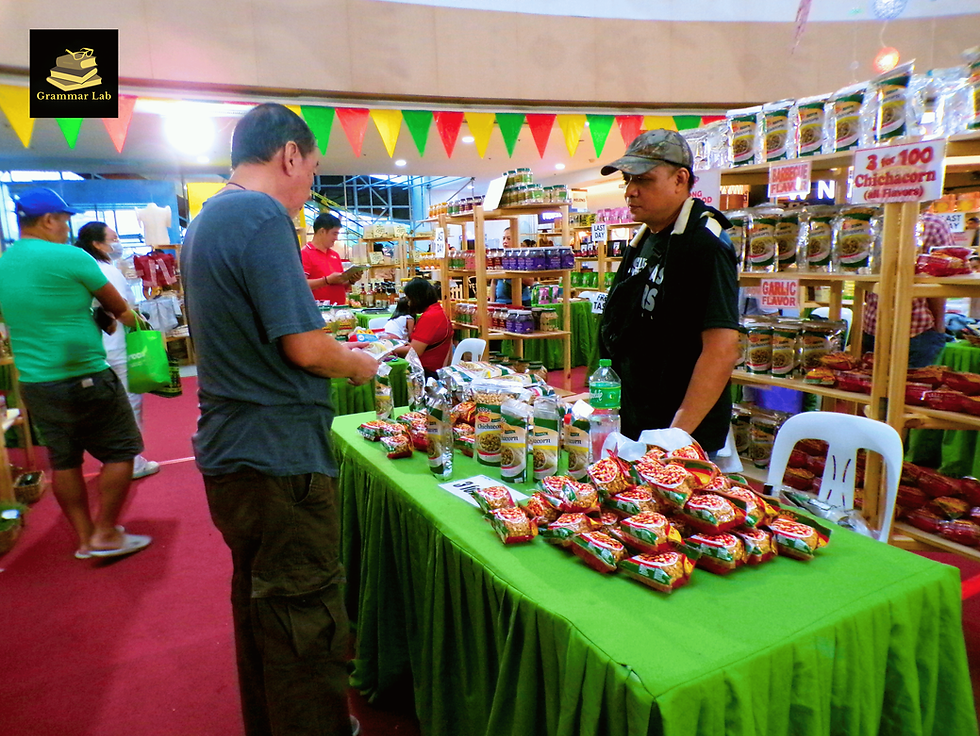
The Philippine economy soars towards hitting national targets, aiming to bring about improved commercial performance, better global economic standing, and, most importantly, better living conditions for Filipinos. Various factors come into play in this tedious, intricate process, where a concerted effort of numerous industry players breaks open the lid to success. As complex and technical these economic factors may seem, there are simple, tiny business units that directly contribute to the economic journey of the Philippines and, ultimately, to the nationwide pursuit of national progress—the micro, small, and medium enterprises (M.S.M.E.s). These commercial midgets may not sing in mind whenever business enters the discussion, but M.S.M.E.s put in a great deal of share in the Philippine economy.
M.S.M.E.s significantly form the Philippine business landscape. They are, indeed, the face of the Philippine commerce. They constitute almost the entire local business registry at around 99.6% from 2020 through 2025 based on government and private-sector data. Specifically, citing 2024 figures from the Department of Trade and Industry (DTI), micro businesses cover 90.66% of the M.S.M.E. sector. That’s 1,125,476 enterprises. Small businesses form 8.6% or 106,799 enterprises. Medium businesses account for 0.37% with 4,633 enterprises.
M.S.M.E.s are classified assetwise and manpowerwise. Businesses whose assets amount to not more than Php3,000,000.00 and employ nine people at most are micro. Small enterprises are those with more than Php3,000,000.00 but not over Php15,000,000.00 assets and workforce of 10 to 99 staffers. Medium businesses carry assets valued at more than Php15,000,000.00 but below Php100,000,000.00 and employ 100 to 199 people.
Statistics show that M.S.M.E.s commonly engage in retail, food, and manufacturing. Many also operate as automobile-care providers and financial institutions.
M.S.M.E.s are key drivers across industries in the country. They mirror Filipino courage, determination, and optimism amid a highly competitive market not only locally, but also globally. Their number overwhelmingly steers trade and consumption both in rural and urban areas throughout the Philippine territory. It is for this reason that their rise—and fall—triggers a massive impact both on the government and the populace.
M.S.M.E.s are the “on-the-ground providers” for Filipinos: they often sprout and operate at the community level, drawing business inspiration from what folks truly need. In nearly every place, it’s not hard to spot a nearby “karinderya” or fast-food store, where you fill a growling stomach. It’s also not too afar that a vehicle repair shop sits, where you bring your clanking motorcycle or automobile for some fixing and fine-tuning. Moreover, somewhere around operates a “sari-sari store” or convenient store, where you buy condiments for your dish, toiletries for hygiene, and other personal and household essentials for daily survival.
M.S.M.E.s also open a wide avenue to cutting down unemployment. On a micro level, for instance, a fast-food store in the neighborhood that hires two helpers and one cook immediately takes out three individuals from the pool of jobless people.
M.S.M.E.s, in addition, serve as a staunch ally of the government in generating revenues in the form of value added tax and income tax, among other types of taxes applicable. With their majority share in the country’s business roster, the taxes they remit to the government are in no case petty and insignificant. The amount is indispensable, indeed.
Still vivid in my memory is my one-on-one interview with Ma. Cristina A. Roque during the 2024 National MSME Summit, who was then the DTI undersecretary for the MSME Development Council. During our conversation, she enthusiastically shared her personal insights about the overall positive status of Filipino M.S.M.E.s and the vibrant future that awaits these vital enterprises.

Department of Trade and Industry (DTI) secretary Ma. Cristina A. Roque,
formerly the DTI undersecretary for the MSME Development Council
Approaching her as a writer from Grammar Lab, I first asked her how important are M.S.M.E.s in the Philippine commerce. Roque smiled and confidently stated the engulfing majority of M.S.M.E.s in the Philippine commerce.
“M.S.M.E. comprises 99% of the businesses in the Philippines. Definitely, it’s very important for the business in the Philippines, and it’s very important for the economy,” said she.
Next, I sought her thoughts of the present status of M.S.M.E.s in the Philippines. Her response pointed to the pressing need for these budding ventures to grow up and take their businesses to the next level.
“The status of the M.S.M.E. sector in the Philippines [is], of course, they need a push. They still need to be able to improve and level up wherever they are. Let’s say, if they’re micro, they need to level up small; if they’re small, they need to level up to medium; and if they’re medium, they need to level up to large. That’s the status of the M.S.M.E. in the country,” explained Roque.
I then solicited her personal advice for M.S.M.E.s to thrive amid the present competitive market in the Philippines. Roque gave a touching guidance while motivating these enterprises to seize the growth opportunities offered by the commerce department.
“To all the M.S.M.E.s, better take advantage of the opportunities given by the Department of Trade and Industry and other opportunities that are given to you. When you see a chance, or if you have the talent, I suggest that you take that chance. You take the chance to make your business grow or to be able to level up, or to make a change, or to be able to bring out the best in each and everyone of us because we will never know we might be the next success story,” advised the for DTI undersecretary.
I then moved to hear her prognosis of the M.S.M.E. sector five years ahead. Roque projected an empowered M.S.M.E. sector in the Philippines, ready to meet the rising demand of the domestic and foreign market.
“Definitely, the M.S.M.E. sector will be really leveled up. With the strong tourism and the strong economy of our country, because our country now is open globally, so many are ready, and tapos na rin [ang] pandemic. Because of our tourism, our beaches . . . now we’re called the emerging market or the emerging giant now, so a lot of tourists will come in, and a lot of businesses will grow, so the M.S.M.E.s really have a bright future ahead, and the Department of Trade and Industry has a lot of programs for the M.S.M.E.s for them to take advantage and to use the programs for them to be able to level up and to be able to be the best that they can be,” shared Roque.
As a parting item on my list, I requested her to give a personal message to Filipino M.S.M.E.s. With a shining smile and utmost optimism, Roque urged the M.S.M.E.s to continue mastering their playing field while aiming for excellence.
“To the Pinoy M.S.M.E.s, never cease learning. Always want to learn because you’ll never know. Actually, knowledge is power. You will never know when you’ll use them, or you may use them. But if you don’t use them, then parang nand’yan lang s’ya. And if there’s a chance or if you got the talent, why don’t you take it to the next level or to be able to make the best out of our life. Remember, we only have one life to live. Let’s give it our best. Sayang din naman ang buhay na binigay ng D’yos if we don’t make the best out of it. We’re already here. Ibigay na natin ang meron tayo, then let’s stop the ‘pwede na’ attitude. Let’s go for excellence,” advised Roque.
Roque eventually became the acting secretary of the DTI following the resignation of then secretary Alfredo E. Pascual. Not long after, President Ferdinand R. Marcos Jr. vested Roque with full-fledged leadership of the commerce department by appointing her as the next DTI secretary.
M.S.M.E.s play a pivotal role in the Philippines’s bid for economic development and overall national progress. As the backbone of the Philippine economy, these humble enterprises serve as direct providers to communities, agents of unemployment reduction, and streams of revenue for the government. Regardless of their individual size, they are undeniably a decisive instrumentality as the country pounds for improved economy, reputable commercial image in the international scene, and better living conditions for the Filipino people. It may not be an exaggeration to describe these humble enterprises as the cradle of the Philippine economic voyage.
M.S.M.E.s, rise up, be proud, stand out!


Comments